Migrating to Erudus API version 2: Everything You Need to Know






Last year we announced Erudus API Version 2 - significantly more powerful, with a richer data model, smarter endpoints, and schema-specific attributes that open up possibilities that simply weren't there before.
API v2 takes over from API v1 - which will be sunset at the end of 2026, so migration isn't something to put off. But if you don’t know where to start don’t worry - this is your essential guide to undertaking the migration process.
Whether you're a Manufacturer managing product data, a Wholesaler, or a third-party integration partner pulling data from our Data Pool, we've broken it down so you know exactly what's changing and what you need to do.
What's changing?
For all API users
Attribute names have changed
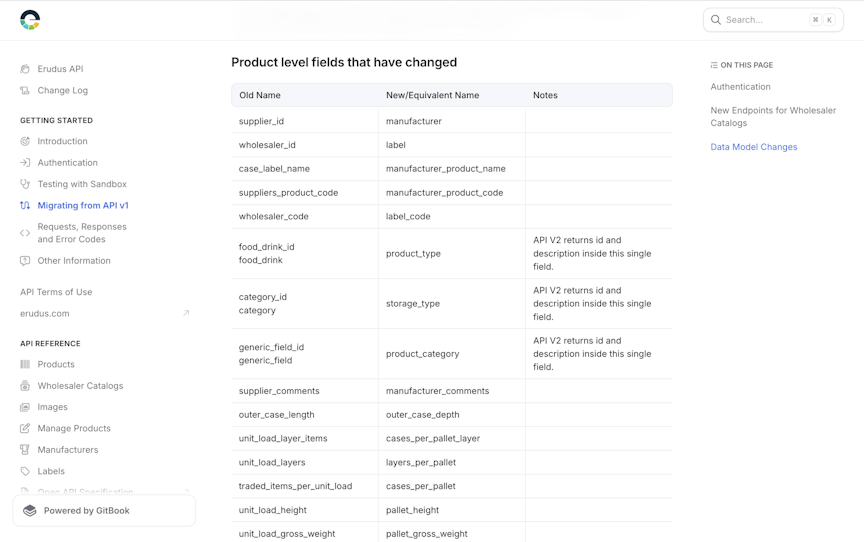
One of the most significant things to be aware of when migrating is that a number of attribute names have changed between v1 and v2.
This means your integration will need to remap field references to the new names.
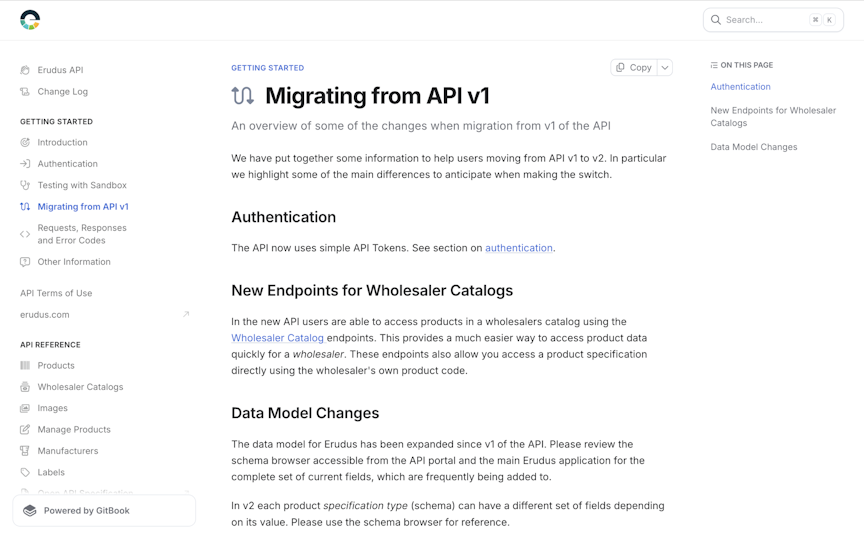
We've made this as straightforward as possible. The Erudus developer documentation https://developer.erudus.com/getting-started/migrating-from-api-v1 includes a full mapping table showing the old v1 field names alongside their v2 equivalents — both at the product level and the component level.
For example:
- supplier_id is now manufacturer
- case_label_name is now manufacturer_product_name
- suppliers_product_code has become manufacturer_product_code
Important Reminder Erudus API Version 1 is being retired
API v1 will be switched off at the end of this year. If your integration is currently running on v1, now is the time to plan your migration.
Some fields have also been retired entirely, and there's a clear indication of those in the documentation.
Working through these mappings systematically against your current integration is the most important first step, and the developer docs are your key reference for doing so.



Some attributes have been retired, and there’s a wealth of new ones
In building v2 we took the opportunity to retire some attributes that were no longer fit for purpose, and to significantly expand the dataset. There are now far more attributes available across the data model, giving greater depth, clarity, and accuracy to the data in the Erudus pool.
We'd strongly encourage everyone - Manufacturers and Wholesalers alike - to review what's newly available in v2:
For manufacturers, the expanded attribute set means you can provide more comprehensive and detailed information about your products through the API than ever before. Taking the time to review and populate new attributes is an investment that makes your product data more useful to everyone in your supply chain who relies on it.
For wholesalers and integration partners, the new attributes available in v2 are an opportunity to make your solutions more robust. There is significantly more data accessible that can enrich the experiences you build for your customers.
New Product Specification Types with schema-specific attributes
One of the most exciting developments in v2 is the introduction of product Specification Types - distinct schemas that reflect what type of product is being published. Different product types have different data requirements, and v2 reflects that properly.
Each Specification Type (or schema) has its own set of product-specific attributes. To take one example, Fish and Seafood specifications allow Manufacturers to declare:
- Fish species names
- Catch zones
- Catch methods
These are attributes entirely specific to that product type and aren't shown on other schemas.
You may also be interested in…


You may also be interested in…
Manufacturers New Enhancement: Product Specification Type
ReadThe same logic applies across specification types, with each one surfacing the attributes that are genuinely relevant and meaningful for that category of product.
Erudus users can browse all available schemas at https://app.erudus.com/schema and the API documentation provides further reference for working with different specification types in your integration.
For Wholesalers and third-party integration partners
2 sets of endpoints: Products and Catalog
In v2, there are now 2 distinct sets of endpoints for accessing product data, and understanding the difference between them is important for designing your integration correctly.
Product endpoints give you access to the latest version of products in the main Erudus Data Pool. Use these when you need to search or retrieve product data from across the pool at large.
Catalog endpoints are new in v2 and are designed specifically for Wholesalers. A Wholesaler Catalog contains products that have been assigned a Wholesaler's own internal product codes. Crucially, these catalog entries can be pinned to a specific version of a product — which may differ from the latest version in the main pool. This gives Wholesalers precise control over which version of a product their downstream systems and customers see. Catalog endpoints also allow you to retrieve a product directly using the Wholesaler's own product code, rather than the Erudus ID - making it significantly easier to integrate with systems that are keyed on your internal codes.
For most Wholesaler-driven integrations, the Catalog endpoints will be the primary route to the data you need.
Daily API call allowances and shared pools
In v2, Wholesalers receive 2,000 or 4,000 API calls per day, based on their subscription tier. 2,000 for Premium subscriptions and 4,000 for Pro subscriptions.
It's important to be aware that this is a shared pool across all tokens issued from a Wholesaler account - meaning every integration and every API token drawing on that Wholesaler account counts against the same daily allowance.
If a Wholesaler needs a higher daily call limit, this can be arranged, Wholesalers can contact Erudus support to discuss increasing the allowance.
If you are an Integration Partner building on top of a Wholesaler's Erudus data, you are drawing from that shared call pool alongside any other Erudus integrations the Wholesaler has in place. It's worth being thoughtful about call efficiency in your integration design: fetching only what you need, using filters effectively, and avoiding unnecessary calls where possible will help ensure the daily allowance goes further for everyone.
Managing API access: you're in control
Wholesalers have full control over who can access their Erudus data via the API. Rather than Integration Partners managing their own access independently, tokens are issued and managed at the wholesaler level — meaning you decide who gets access, and you can review usage and revoke access on a per-token basis at any time.
This is important for a few reasons. Given that all tokens draw from a shared daily call pool, being able to see usage broken down by token means you can spot if any single integration is consuming a disproportionate share of your allowance. And if a partnership changes or an integration is decommissioned, you can revoke that token immediately without any impact on your other integrations.
To be able to manage tokens for your account, you'll need an API administrator user set up on your Wholesaler account. This is something the Erudus Support Team can arrange for you quickly - just get in touch and they'll set you up to access the Erudus API portal.
Getting started with API v2
To get access to the v2 API, contact the Erudus Support Team via:
- Email: support@erudus.com
- Phone: 0333 121 89 99
Their opening hours are Monday – Friday, 09:00 – 17:00.
Full developer documentation, including endpoint references, authentication guidance, and the complete v1-to-v2 field mapping, is available at https://developer.erudus.com/
Still got questions?
We know that migrating an API integration isn't a trivial thing, and every use case is different. In addition to setting you up, the Erudus Support Team are more than happy to jump on a call or an online meeting with you to talk through your specific integration, help you troubleshoot, and work out the best approach to implementing v2 for your particular solution.
Don't hesitate to reach out - we'd much rather help you get it right than have you stuck. Contact support@erudus.com or call us on 0333 121 89 99.